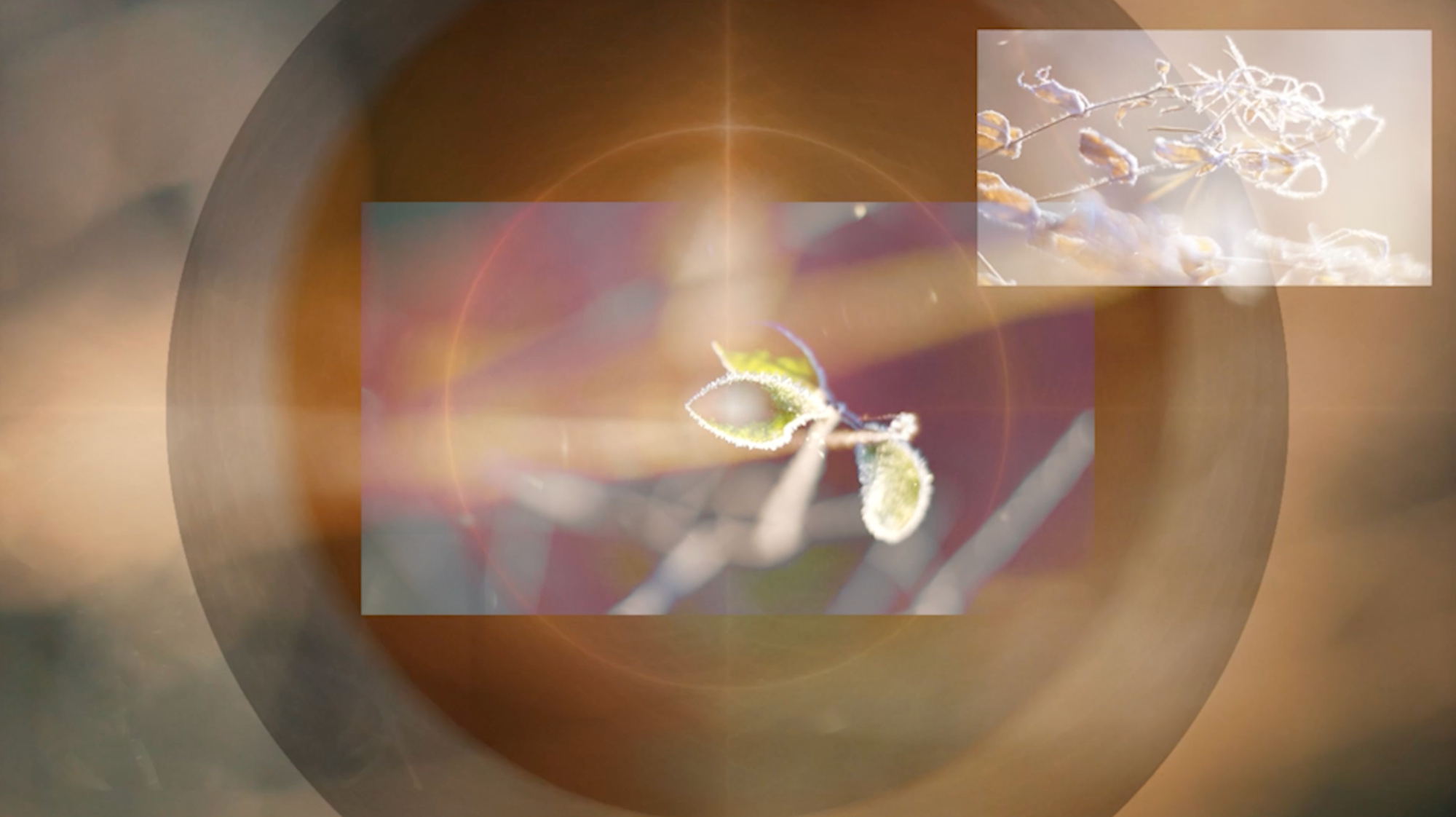
Suture
2026The suture is not visible at the surface. It is detectable only through its effects: the deformation of what surrounds it, the anomalies in the field, the presence of mylonite where the rock has been ground under pressure until something new was produced from what was forced together.
1. Research Position and Situatedness
Suture is a practice-based research project that diffracts Povinelli's analysis of geontopower (2016) through the procedural logic of Pennisi's Envion system (2024–2025), producing a semi-generative, semi-chaotic visual ecology that enacts the logic of the extractive survey rather than illustrating it. The system does not represent geontopower. It behaves according to its principles: classifying visual matter by what the algorithm determines is valuable, organising it by affinity rather than by the matter's own relations, serving it to the performer as a continuous stream of fragments read for pattern and yield. And it withholds the consummation of that logic — not by stepping outside it, which the running infrastructure forbids, but by holding the same reading as an avowed partial trace rather than acting on it as fact.
The research is grounded in direct professional experience. Prior to becoming an artist-researcher, the researcher worked as an exploration geologist across multiple operating contexts — West Africa, Australia, and Papua New Guinea. In each context the technology and the logic were consistent: Reverse Circulation (RC) drilling, in which a drill bit pulverises rock at depth and compressed air drives the fragmented material back up through the inner tube to the surface as a continuous stream of chips. Fast, efficient, indifferent. The stratigraphy, the relationships within the rock, the land's own organisation of its matter — all become chips. At the surface the chips are sampled, split, and assayed: read for what the company is looking for. Everything else is waste.
What varied across these contexts was not the operational logic but its consequences and the degree to which those consequences were visible. In West Africa, in Australia, in Papua New Guinea, the researcher encountered distinct forms of the same suppression: indigenous and local community relationships to land rendered illegible by the resource industry's requirement that land be treated as substrate. The relationships to country that Povinelli's framework names as what geontopower cannot recognise were not abstract in these contexts. They were present, insistent, and systematically overridden. The degree of impact varied. The structure of the override did not.
The researcher left the industry due to accumulated ethical concern about that suppression and the researcher's own implication within it. Povinelli's argument resonates with friction: it is a description of something the researcher was inside, was implicated by, and departed from. The friction is not incidental. It is not resolved by the work. It is what the work is made from.
The researcher was operating geontopower's logic with a drill. Suture enacts that logic with an algorithm. The difference is the research.
The design and construction of Suture has been substantially assisted by artificial intelligence — a collaboration that is itself entangled with the extractivist infrastructure the work interrogates. The computational resources consumed, the energy cost of each inference, the planetary matter embedded in the hardware, the extraction chains that produced both: these are part of the work's material conditions. The work does not stand outside this entanglement. It names it (Moll, ongoing).
2. The Name
Suture names a condition rather than a place. In geology, a suture zone is a buried boundary where two distinct crustal blocks were forced together under the collision of tectonic plates. It is not visible at the surface. It is detectable only through geophysical survey: through anomalies in the field, through deformation patterns in the surrounding rock, through the presence of mylonite — the highly sheared metamorphic rock produced where material has been ground under such intense pressure that it has been reorganised at the mineral level while retaining traces of what it was. The suture is the record of a forced proximity. It does not announce itself. It is read through its effects on everything around it.
The word also carries a textual and theoretical register: in Lacanian theory and film studies, suture names the process by which the subject is stitched into a symbolic structure that precedes and exceeds them. The subject occupies a position in a system whose logic was established before their arrival and will continue after their departure. This resonates with the researcher's professional experience: entering a drilling programme already designed, executing a survey whose purpose was determined elsewhere, occupying a position in an extractive apparatus whose logic required no individual to understand it in full.
Reverse Circulation — the specific drilling technology the researcher deployed in the field — operates as the system's internal technical metaphor. It is not visible in the project's name, but it structures the pipeline, the corpus, the performance environment, and the philosophical architecture of the work from the inside. The name Suture speaks to what the encounter left. RC names what produced it.
3. Geontopower: The Theoretical Ground
Povinelli's Geontologies (2016) argues that late liberal governance operates not only through the management of life (biopower, in Foucault's terms) but through the management of the distinction between Life and Nonlife. Povinelli calls this formation geontopower.
The distinction between Life and Nonlife is not a natural category. It is a political technology: it determines what forms of existence have interests, relations, and rights, and therefore what can be extracted from without remainder. In settler late liberalism, the question of whether a sacred site 'listens' — whether geological matter has intentions, relations, and a form of life — is a governance question with direct material consequences for land rights, mining access, and the legal standing of Indigenous relationships to country. The resource industry operates by treating geological matter as genuinely inert: as substrate without relations, without interests, without the capacity to be wronged by extraction. This is not a scientific claim. It is a governance operation.
A critical clarification: geontopower is not a new ontology of geological matter. Povinelli is explicit that she is not proposing that rocks are alive, that geological matter has consciousness, or that the Life/Nonlife distinction should simply be reversed. She is diagnosing a specific formation of power and showing how it operates through the maintenance of a distinction that serves governance functions. Suture does not dissolve this distinction. It enacts the governance operation and then withholds its consummation, making both states available as orientations the system moves between rather than necessities.
The Animist risk is worth naming directly. A practice that works with geological matter and biological process vocabularies can easily slip into the Animist position — the insistence that all matter is vital — which Povinelli identifies as a figure produced by and within geontopower rather than a radical exit from it. Suture refuses this position structurally. ORE enacts the extractive gaze, not its dissolution. BODY withholds the gaze's consummation — not to reveal the matter's own vitality, and not to recover a wholeness the system never had access to, but to hold the same reading as an acknowledged partial trace rather than acting on it as resolved fact. The same refusal extends to the geological sublime: to render BODY as awe at the imperceptible vastness of deep time would re-enchant Nonlife, restoring to inert matter a grandeur that commands reverence — the Animist move in another key, and as fully a position produced within geontopower as the one it appears to oppose. BODY shows a vector, not a vastness; an indication, not a whole.
4. Pennisi's Envion and the Encounter Model
Emiliano Pennisi's Envion system (2024–2025) is the direct technical and philosophical antecedent for Suture. Envion is a procedural audio corpus system that retrieves sound matter from Internet Archive, subjects it to spectral and temporal transformation, and navigates the resulting corpus through audio-reactive logic. Pennisi's concept of 'found net sound' — the encounter with archived matter as a compositional act that resists curation and selection — establishes the philosophical foundation that Suture builds its visual equivalent upon.
The encounter model is central to both systems: matter is not chosen for its properties but found through procedural retrieval. The composer's role is to establish conditions for encounter rather than to select outcomes. Where Suture extends Pennisi's model is in the specific relationship between the encounter logic and the geontopower framework, and in the distinction between corpus construction (the drill: raw, unevaluated) and corpus navigation (the assay: organised by yield). The audio analysis layer of the Suture visualiser is designed with named signal outputs that would allow Envion's audio corpus engine to be integrated directly.
5. The Survey and the Logic of Reverse Circulation
Reverse Circulation drilling is the dominant technology in mineral exploration. The bit pulverises. The air reverses the circulation. The chips rise. At the surface, a geologist logs the chips: colour, texture, mineralogy, alteration. The assay returns numbers. The programme advances or abandons. The drill moves on.
The RC cycle is geontopower made mechanical. The distinction between what is valuable and what is waste is made at the assay stage, after the matter has been fragmented and brought to the surface. The rock at depth had no say in whether it would be found interesting. Its relations — to the country above it, to the water moving through it, to the surface expressions that marked its presence to those who knew how to read them — are irrelevant to the programme. The programme reads for metal. Everything else is logged as barren and the drill moves on.
The Suture pipeline is structured on the RC cycle. The corpus construction stage is the drill: it extracts frames from video in fixed-length consecutive windows — preserving the temporal sequence of what came up from the drill — and brings them to the surface without regard for what they were part of. The CLIP classification is the assay: it reads the frames for visual affinity, determines what belongs together, and organises the corpus accordingly. The stratum directory is the chip tray. The accretionary loop is the rehabilitation requirement.
BODY in the performance environment traverses the corpus sequentially: the playhead moves through the ingestion-ordered frames as they came up from the drill, forward and backward, without the classification's determination of what belongs together. BODY does not step outside the extractive apparatus. It borrows a second concept from the same discipline: the ore vector — a sample that contains no economic mineralisation but whose alteration mineralogy and geochemistry record its position within the hydrothermal system that produced the deposit. The sample holds the system's signature and the signature has a direction. BODY arrests at the vector: it sees exactly where the ore lies and holds short of going to take it. ORE follows the vector to the deposit and consummates the reading.
BODY is the default resting state. ORE is the toggle — the extractive orientation engaged on demand. The asymmetric oscillation between them carries the argument: the dominant gravity is toward extraction; BODY is the temporary, recurring assertion of partiality within that gravity. This is not a reversal of the RC programme's logic. It is the RC programme run with the final step withheld.
6. The Corpus as Raw Geology: A Justification
A crucial design decision, made during the development and testing of the system, concerns what the corpus contains. Earlier iterations of the pipeline applied baked-in pixel transformations during corpus construction (edge geometry isolation, spectral decomposition, optical flow abstraction). Testing demonstrated that these transformations produced "degenerated" material — abstracted imagery that was visually incoherent at the rates and frame densities required for temporal traversal. More fundamentally, they were philosophically wrong: they treated the corpus as a site of aesthetic processing rather than as the chip tray — the place where what came up from the drill is logged before the assay reads it.
The corpus is now raw photography: frames as they came up from the drill, normalised but untransformed. Three consequences follow.
First, CLIP classification receives genuine photographic content rather than artefacts of prior processing, and the resulting strata are more coherent as visual clusters. The assay reads what is actually there.
Second, visual transformation — now understood as diagenesis — happens live in the browser renderer, driven by audio in real time. Luminance bloom, feedback spiral accumulation, and point-cloud shape-noise are applied to raw photographic material in the performance environment. Every performance session produces a distinct diagenetic product from the same raw corpus. The same geological samples, different readings.
Third, BODY's sequential traversal is coherent. The frames within each clip are genuinely consecutive — 100 frames of 4 seconds of continuous footage — because the pipeline now extracts them that way: fixed-length horizon windows on a periodic duty cycle, with incomplete trailing windows discarded outright. Earlier scene-change-detection extraction specifically broke temporal sequence, keeping only frames at discontinuities. This was the opposite of what BODY requires. The new extraction preserves the drill's actual return: the material as it came up, in the order it came up.
The decision to move visual transformation to the browser renderer is philosophically sound because it separates the assay (classification: what does this material cluster with?) from the diagenesis (transformation: what does this material become under pressure?). The chip tray holds raw chips. What you do with them after reading is a separate operation.
7. Diffracting Geontopower Through Visual Practice
Barad's diffractive methodology (2007) reads phenomena through one another rather than reflecting them from outside. A diffractive account of geontopower does not stand outside the formation and describe it. It passes the phenomena of geontopower through another apparatus — in this case, a procedural visual system — and attends to the patterns of interference produced in the passage. The resulting pattern is not a representation of geontopower. It is what happens when geontopower's operational logic is run through a visual pipeline, and the interference between those two things is what the work produces.
Suture diffracts geontopower through the RC cycle, through Pennisi's encounter model, through the researcher's own biographical entanglement with the resource industry. Each of these is a lens that transforms what passes through it. The interference pattern they produce together is not reducible to any of them individually. This is why the work is called Suture rather than a more declarative title: it does not announce its argument. It is the zone of deformation where the argument has already happened, and what remains is the reorganised matter.
8. Extractivism, Infrastructure, and Complicity
The project takes a position of critical complicity rather than refusal in relation to extractivism. Taking copies of visual matter while leaving originals intact is a partial refusal of extractivist logic — the source is not depleted. But the system operates on extractivist infrastructure: hardware built from mined materials, data centres consuming energy from fossil and nuclear sources, server networks sustained by labour disproportionately located in the global south while the benefits accumulate in the global north (Yusoff, 2018). The RC programme the researcher once operated extracted material wealth from country. The Suture pipeline extracts computational value from infrastructure built on equivalent extraction chains. The tool has changed. The chain has not.
This is not a confession. It is an analytical statement about the conditions of the work's production. Moll's practice of making the material costs of digital operations concrete and visible (joana.moll.com, ongoing) is a methodological reference point: the system's own energy entanglements are part of its research content, not an embarrassment to be managed.
9. Practice Context 9.1 Emiliano Pennisi — Sonic Antecedent and Philosophical Ground
Pennisi's Envion system (2024–2025) is the direct antecedent. Envion establishes the encounter model — found matter, procedural transformation, audio-reactive navigation, resistance to curation — that Suture extends into the visual domain and situates within the geontopower framework. The potential for future integration between Envion's audio corpus engine and Suture's visual system is architecturally prepared in the design of Suture's audio analysis layer.
9.2 Semiconductor — Geological Data as Audiovisual Matter
Semiconductor's Earthworks (2016) translates seismic data into audio controlling evolving strata of colour, deliberately exposing limitations and human error in scientific data. The critical distinction: Semiconductor works with geological data as content. Suture works with any visual matter through a pipeline modelled on geological extraction logic. The geological is in the method, not the subject.
9.3 Hito Steyerl — The Poor Image
Steyerl's 'In Defense of the Poor Image' (2009) names digital copies stripped of context through circulation and degradation. The Suture visualiser produces its own "poor images" through the live diagenetic process — but through deliberate, audio-reactive transformation of raw photographic material in performance rather than through network circulation. Steyerl's poor images are accidental products of capitalist circulation. Suture's transformed matter is the deliberate product of a live diagenetic event, never fixed, never the same twice.
9.4 FluCoMa — Corpus Practice
The Fluid Corpus Manipulation project (University of Huddersfield) enables musicians to integrate machine listening and machine learning in Max for programmatic data mining of large sound corpora, described as 'enabling programmatic data mining as musicking' (Tremblay et al., 2021). This is the sonic equivalent of what Suture does with visual matter, and the FluCoMa community constitutes Suture's primary distribution audience.
9.5 Joana Moll — Material Costs of Digital Infrastructure
Moll's practice makes concrete and visible the material costs of digital operations: the energy consumed per Google search, per email, per hour of streaming. Her methodology is a direct reference point for Suture's acknowledgment of its own infrastructure entanglements. The work does not externalise its energy costs. It names them as part of its research content.
9.6 Diffracting Digital Images
Dawson, Meirion-Jones, Minkin, and Reilly's Diffracting Digital Images (2022) applies Barad's diffractive methodology to digital imaging practice in archaeology and art, arguing that digital images are not stable entities but in-the-making through intra-active processes. Their engagement provides the closest existing academic work to Suture's methodological position on the digital image as produced rather than found.